
Technical details
Orthopedic modifications described on the Northopedic prescription form, for foot-care professionals and their clients.
LLD, rockers & lifts
We split the sole and insert lifts, keeping the original walking surface of the soles intact. If splitting is not possible, lifts are added to the walking surface of the shoe, matching the material and colour of the original sole.
Unilateral lifts are applied to footwear for patients with a Leg Length Discrepancy (LLD). Rockers (bilateral lifts) stiffen the soles to control rocking motion while walking.
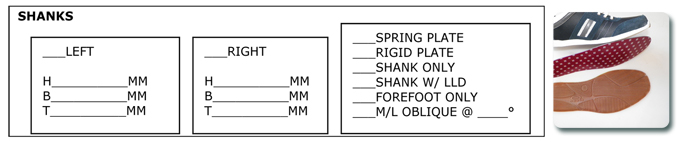
The profile of lifts and rockers is measured in millimetres (MM) at three points on the sole using the rocker profile formula: (H) Heel Centre = 100%; (B) Ball (widest area on sole) = 75%; (T) Toe Tip = 25%. Heel-to-ball lifts taper from the ball line to the heel. For a heel lift only, the taper starts 12 MM proximal from the ball line.
Rocker profiles: Short — tapering forefoot, 2/3 distance between ball line and toe; Medium — tapering, 1/3 distance between ball line and toe; Long — begin at ball line, taper to toe.
Standard: taper straight through the centre line. We can deviate from this when needed to accommodate the patient’s stance by moving the lowest point of taper at the toe tip medially or laterally oblique. Standards: (M) Medial oblique — 12 degree angle from centre line; (L) Lateral oblique — 8 degree angle from centre line.

Sole flares & buttresses
Sole flares are added left, right or bilaterally — medial, lateral or both — to increase the width of the contact surface to the ground, increasing stability. Standard widths of sole flares are 6 MM, 9 MM or 12 MM.
Sole flare length measures from the centre seam of the heel counter to 6 MM behind (posterior) the ball. Sole flares extended to the upper part of the shoe create a wall (buttress), increasing stability.

Shanks & plates
Shanks and plates are embedded inside the sole to stiffen the shoe and are made of plastic, metal or carbon fibre. Standard options are full length or forefoot only.
Shanks are installed with or without bilateral rockers or a unilateral LLD lift. Shanks with rockers create extra stiffness and complete control over the rocker profile. The toe profile is neutral, medially or laterally oblique. Shanks and plates are flexible (spring plate) or stiff (rigid plate).
Repairs & lace-to-Velcro conversions
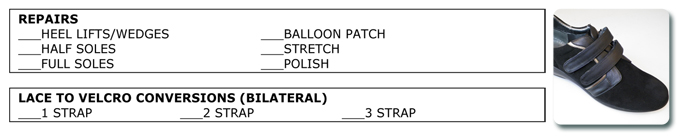
Repairs include heel lifts and wedges to repair worn heels; half soles to repair worn soles; full soles to replace the complete bottom of shoes; and stretching shoes or installing a balloon patch to relieve pressure areas.
Bilateral lace-to-Velcro conversions are beneficial to patients who have difficulty tying shoelaces. We design a two-strap or three-strap system, or a one-strap pad system. With the pad system, laces stay in place and become decorative, while closure is made with Velcro.
Discuss a modification
For more customized modifications, contact The Cobbler to discuss your requirements.